
The fear is the wrong fear
Finance professionals have spent two years reading articles about their own obsolescence. AI will automate the bookkeeper. Autonomous agents will replace the CFO. The profession is on borrowed time.
It's a compelling narrative. It's also mostly wrong — at least for the businesses it claims to be about.
The automation story is being written by enterprise vendors selling to banks and multinationals, by consulting firms whose smallest client has a finance team of fifty, and by professional bodies publishing AI frameworks that nobody outside a Big 4 conference room will ever read. It has very little to do with the founder-led business doing $15 million in revenue, running Xero, and trying to figure out why gross margin moved three points last quarter.
Nobody is building an autonomous finance function for that business. And even if they were, it wouldn't work without someone who understands the context.
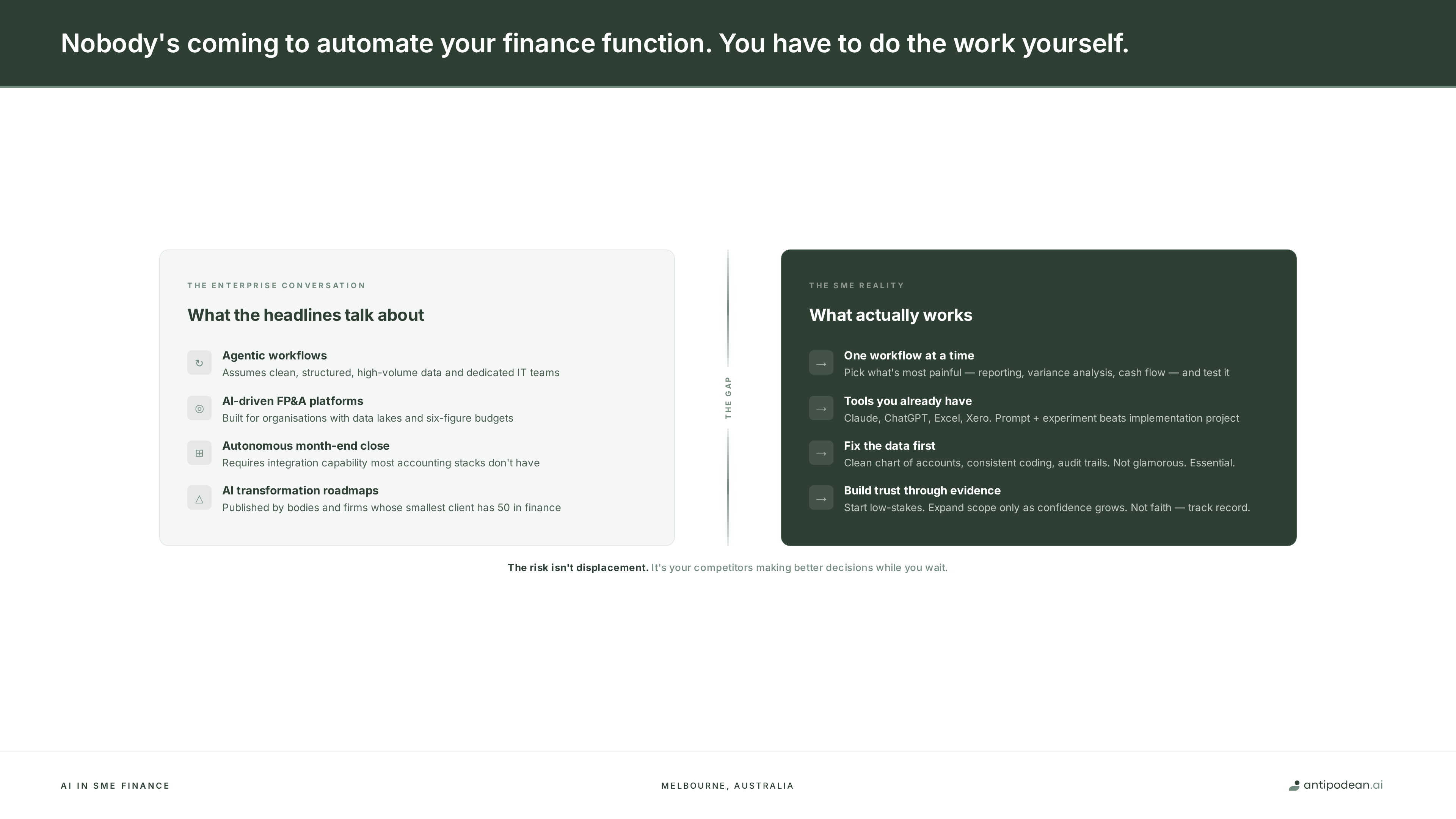
Enterprise AI doesn't translate down
The tools making headlines — agentic workflows, AI-driven FP&A platforms, autonomous month-end close — are built for organisations with clean, structured, high-volume data and IT teams to implement them. They assume data infrastructure that most SMEs haven't built. They assume integration capability that most accounting stacks don't have. And they assume a budget that makes the whole conversation academic.
The accounting software vendors are adding AI features. Some of them are useful. Most of them are pattern-matching on clean transactional data, which is fine, but it's not insight. It's not the kind of analysis that changes a decision.
The gap between "AI in enterprise finance" and "AI in SME finance" isn't just scale. It's data quality, it's decision-making structure, and it's the fact that in a $20 million business, the person running finance is often also running three other things.
The real blockers aren't technology
If the tools aren't the problem, what is? Three things, consistently.
- Trust. Finance teams are rightly sceptical of outputs they can't explain. When an AI model produces a cash flow forecast or flags an anomaly, the question isn't whether it's technically accurate — it's whether anyone in the business will act on it. Trust is earned through transparency, through a track record of being right. You don't get that from a demo.
- Data quality. AI in finance is only as good as the underlying data. Inconsistent coding, manual adjustments with no audit trail, P&L structures that made sense three years ago but don't reflect the business today — these aren't problems that AI solves. They're problems that make AI outputs unreliable until you fix them.
- Role design. Someone has to own the outputs. Someone has to have the decision rights to act on them. In a lot of SME businesses, this is genuinely unclear — not because people are incompetent, but because it was never designed. Adding AI into that ambiguity doesn't resolve it. It amplifies it.
What's actually happening on the ground
While the debate rages in LinkedIn articles and conference panels, SME finance teams are quietly getting on with it.
They're using Claude or ChatGPT to draft board reports, to sense-check analysis, to turn a messy data export into a coherent narrative. They're building simple automations in tools they already have — Excel, Power BI, their accounting platform. They're finding that a well-constructed prompt and a few hours of experimentation does more than a three-month implementation project.
None of this is a transformation. It's not a roadmap. It's a finance manager trying to get better at their job with the tools in front of them.
The real story of AI in SME finance is incremental, practical, and doesn't make for a good conference keynote. But it's compounding.
The businesses building these habits now — better analysis, faster reporting, more informed decisions — are creating an operational advantage that isn't visible yet. It will be.
The inaction risk is bigger than the displacement risk
Here's the thing nobody says in the AI-and-finance conversation: the risk isn't that AI takes your finance person's job. The risk is that your competitors' finance function starts giving them better information, faster, and yours doesn't.
That's not a technology risk. It's a competitive risk. And it's already in play.
The businesses most exposed aren't the ones with the most manual processes. They're the ones where leadership has decided to wait — for the technology to mature, for a clearer use case, for someone to show up with the answer.
Nobody's coming with the answer. The vendors are focused on the enterprise. The professional bodies are publishing frameworks. The consultants are pitching transformations.
You have to do the work yourself.
That means picking one workflow — reporting, variance analysis, cash flow forecasting, whatever is most painful right now — and testing whether AI makes it better. Not deploying a platform. Not commissioning a strategy. One workflow. One experiment. Build confidence from there.
The finance function that learns how to use these tools, and learns what they can't do, will make better decisions. Not because AI is magic. Because better information, interpreted by people who understand the business, produces better outcomes.
That's always been true. AI just changes the cost and speed of getting there.
The question isn't whether your finance function will be affected by AI. It's whether you're the one doing it to yourself first — or waiting to see what happens.
Figuring out AI for your finance team on your own?
Book a free 15-minute call. No pitch, just a practical look at where to start.
Book a Call →