
There's a dominant narrative in AI and accounting right now: automate everything. Invoice capture, bank reconciliation, accounts payable, accounts receivable — feed it all to the machine, cut headcount, watch the savings stack up.
It makes for a clean story. The problem is it doesn't hold up for most Australian SMEs.
If you're running a $5–30 million business with a finance team of two to five people on Xero, the transaction layer is already heavily automated. Bank feeds run. Rules match. Receipt capture works. The marginal gain from layering AI on top of what Xero already does is real — but it's thin. You're squeezing another 10–20% of effort out of processes that aren't broken, for a team that's probably not going to shrink by a headcount as a result.
That's not where the value is.
The three levels
When we work with SME finance teams, we think about AI value in three levels. Not as a maturity model — nobody cares what level they're at — but as a practical map of where the next dollar of AI investment should go, and what it actually delivers.
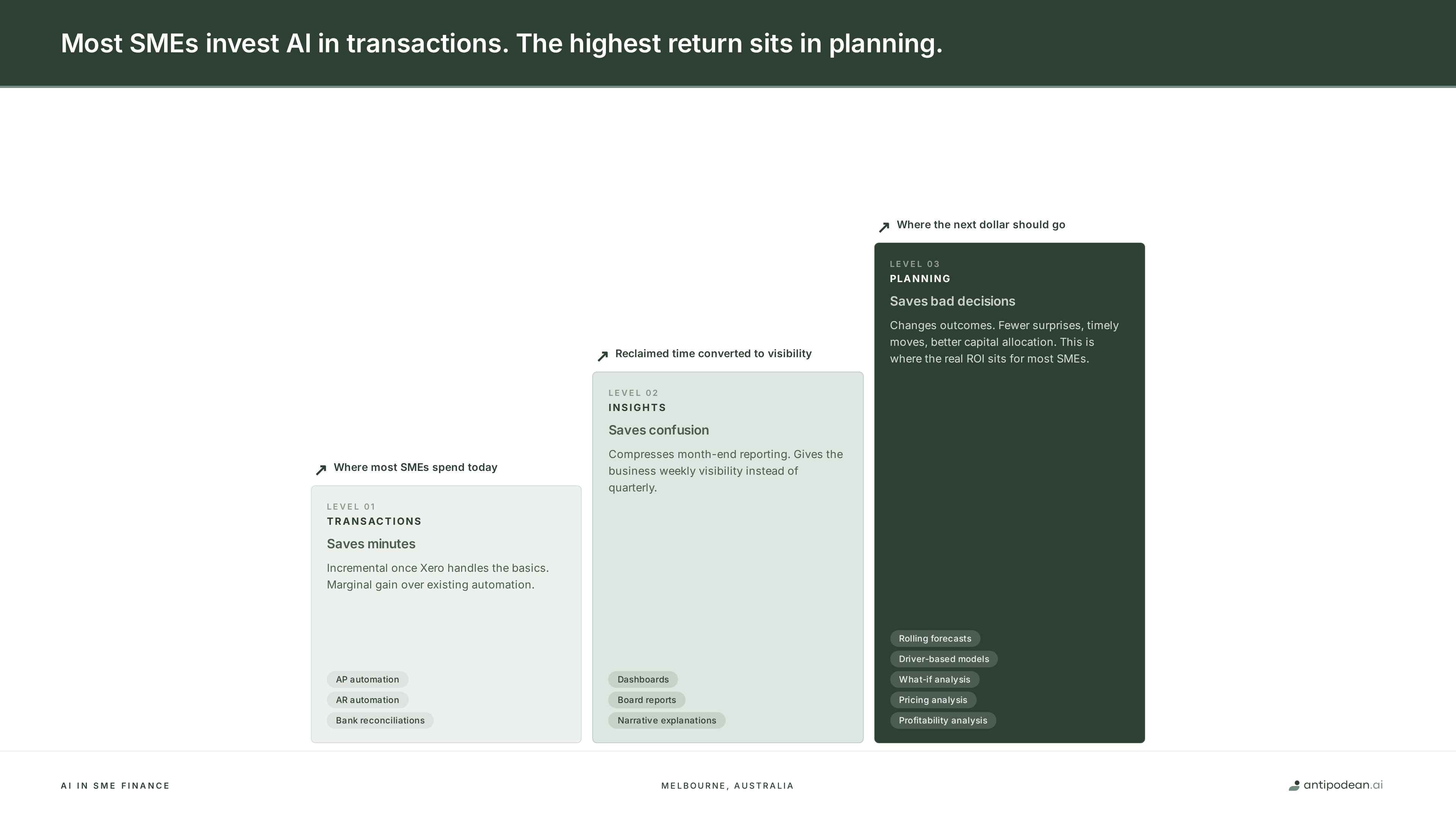
Level 1: Transactions — saves minutes
AP automation, AR automation, bank reconciliation. This is where most vendors pitch, and where most SMEs instinctively look first. The value is real: fewer manual touches, faster close, fewer errors. But for a business already on Xero with bank feeds and basic rules, the incremental gain is modest. You reclaim time, not headcount. The finance team isn't getting smaller — they're getting marginally faster at work that was already semi-automated.
Level 2: Insights — saves confusion
Dashboards, narrative explanations, board-ready reporting. This is the bridge level. The time you reclaim from transaction automation gets converted into visibility — the business sees its numbers weekly instead of monthly, gets plain-English explanations of what moved and why, and stops waiting until month-end to understand what's happening.
This layer matters more than most SMEs think, because the gap between "data exists" and "leadership actually understands it" is usually enormous. AI can help close that gap by generating the narrative, not just the numbers — though the quality varies, and someone still needs to sanity-check what comes out.
Level 3: Planning — saves bad decisions
Rolling forecasts, driver-based models, what-if analysis, pricing analysis. This is where we think the highest-value opportunity sits for most SMEs, and where almost nobody is spending yet.
A $15 million services business flying on gut feel, quarterly actuals, and a static budget from February is making capital decisions in the dark. AI-enabled forecasting doesn't replace the CFO's judgement — it gives them something to judge. Rolling cash projections. Scenario models that used to take a week, potentially run in hours. Sensitivity analysis on revenue drivers that used to live in someone's head. It's not magic — the models are only as good as the data feeding them — but even a rough forward view beats no forward view.
For a Xero-based finance team, this is where the next dollar should go once the data is clean and connected. Not more invoice capture. Not another bank rec tool. Planning. Decisions. Forward visibility.
Why this framing matters
The AI-in-accounting conversation has been captured by the transaction layer because it's the easiest to demonstrate and the simplest to sell. "Look, the invoice was processed automatically." That's compelling for 30 seconds, until you realise the business was already processing invoices — just slightly slower.
The harder sell — and the higher-value one — is the planning layer. It requires cleaner data, more connected systems, and a finance team willing to shift from backward-looking reporting to forward-looking analysis. But the payoff is qualitatively different. You're not saving minutes. You're avoiding bad decisions. You're giving a founder cash visibility they've never had. You're modelling the impact of hiring three people or losing a key client before it happens, not after.
That's the honest state of things right now. AI is useful, increasingly capable, and still imperfect — all at once. Most finance leaders don't fully trust it yet, and for good reason. The businesses that benefit most from this shift won't be the ones that automated the most invoices. They'll be the ones that used AI — carefully, with oversight — to make better calls a bit earlier.
What this means for your finance team
If you're running a small finance function in a growing Australian business, here's the practical takeaway:
First: Get your transaction layer clean and connected. Xero bank feeds, automated matching rules, decent receipt capture. Most businesses are already here or close to it.
Then: Build the insight layer. Automated dashboards, narrative reporting, weekly visibility. Convert reclaimed time into understanding.
Then: Invest in the planning layer. Rolling forecasts, driver-based models, scenario analysis. This is where the compounding returns sit — and where almost nobody in the SME world has started.
The staircase isn't a rigid sequence — you can skip ahead if your data is ready. But for most businesses, the foundation matters. Bad data in means bad forecasts out, and a planning tool built on unreliable transaction data is worse than no planning tool at all. AI doesn't fix a messy chart of accounts — it amplifies the mess.
The point isn't to spend more on AI. It's to spend on the right layer. For most SMEs today, that layer is probably planning — not because transactions don't matter, but because Xero already handles the basics, and the next dollar likely belongs in decisions, not keystrokes.
Not sure where AI fits in your finance function?
Book a free 15-minute call. No pitch, just a clear-eyed look at where you are and what's worth trying next.
Book a Call →